Korouoma Canyon Frozen Waterfalls
Plan your visit to the Korouoma Canyon frozen waterfalls in Finnish Lapland — all six named ice falls from Ruskea Virta to Onnekas, when they freeze, the winter hike and what to wear.
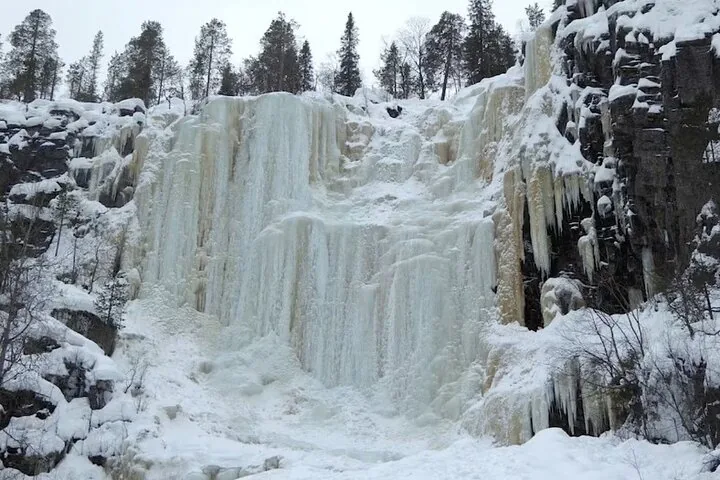
The Korouoma Canyon frozen waterfalls are one of the most striking winter landscapes in Finnish Lapland. Korouoma is a long fracture valley near Posio, southeast of Rovaniemi, and through the winter the streams and springs running down its steep cliffs freeze into huge columns, curtains and walls of ice.
Check Availability

Korouoma Canyon & Frozen Waterfalls Tour with BBQ
- 4.9/5 (343 reviews)
- 7 hours
- Free cancellation
- Guide: EN
Includes Transfers in brand-new 2025 luxury 4x4 vans · Hotel pickup and drop-off · Lunch
You'll choose your date and complete the booking on Viator. Reserve now, pay later on most departures.
Korouoma Canyon at a Glance
| Location | Posio area, Finnish Lapland |
| Distance from Rovaniemi | About 110 km |
| Typical drive | Around 1.5 hours each way |
| Canyon length | Around 30 km |
| Maximum depth | Up to roughly 130 m |
| Main winter attraction | Frozen waterfalls |
| Typical sightseeing hike | About 5 km |
| Typical guided trip from Rovaniemi | Around 6–7 hours |
| Core frozen-waterfall season | December–March |
| Best-known ice falls | Ruskea Virta, Mammutti and Jaska Jokunen |
A visit is not a roadside photo stop. The classic experience involves hiking down into the canyon, walking through snow-covered forest and passing several major ice falls before climbing back to the trailhead. That is exactly what makes Korouoma feel more like an Arctic nature outing than a conventional attraction.
Why Korouoma Is the Frozen-Waterfall Trip From Rovaniemi
Korouoma is the destination to know if you are searching for frozen waterfalls within reach of Rovaniemi, and the reason is that it bundles several things into one day:
- several frozen waterfalls instead of a single cascade;
- canyon scenery with cliffs over 100 metres high;
- a real winter hike instead of a viewpoint stop;
- snow-covered Arctic forest;
- ice climbers on the falls through the season;
- campfire shelters on the route;
- a full-day wilderness outing.
Are There Giant Frozen Waterfalls in Rovaniemi Itself?
Not on this scale. Around the city you will find frozen rivers, rapids and smaller ice formations, but the huge vertical ice walls that appear in most Lapland waterfall photography are Korouoma’s. If giant ice falls are the priority, plan to leave the city for the day, because there is no equivalent closer in.
Why the Frozen Waterfalls Are Special
During the warmer months, relatively small streams flow down Korouoma’s rock walls. Once temperatures stay below freezing, new water keeps arriving and freezing — flowing over the existing ice, and sometimes beneath it — so layer builds on layer. Over weeks and months, modest streams grow into formations tens of metres high.
They can look like blue-white pillars, thick frozen curtains, clusters of icicles or broad walls covering the cliff face. Their shape changes from winter to winter because temperature, snowfall and water flow are never identical. The fall you photograph in February will not be the same shape next year.
Korouoma is also regarded as Finland’s leading natural ice-climbing area, but ordinary visitors do not need to climb anything. The standard experience is a winter hike with viewpoints of the ice falls.
Other Experiences
Other experiences you might enjoy
More ways to explore Korouoma Canyon and Lapland — all bookable with free cancellation.


The Main Waterfalls
Three names matter most on a first visit.
Ruskea Virta
Ruskea Virta, or Brown River, is the largest and highest of the famous falls on the visitor route. Metsähallitus gives the wall as about 35–60 metres high and 40 metres wide, with the routes in the middle rising to around 60 metres. The colouring ranges from white and pale blue to amber or brownish tones depending on minerals, water and light, which is where the name comes from. Water runs strongly here all winter, so the ice builds reliably and the last of it usually lasts until May or June. For climbers it is a serious route, challenging even for experienced ice climbers.
Mammutti
Mammutti, or Mammoth Fall, is another huge ice wall, about 35–50 metres high and 40 metres wide, and it is especially known for blue ice. Spring-fed clear water helps create that characteristic colour. Its broad face holds several climbing routes of varying difficulty, so it is one of the best places to watch climbers and get a sense of the scale.
Jaska Jokunen
Jaska Jokunen, the Finnish name for Charlie Brown, is a tall and often broad formation, about 50 metres high. Its appearance varies considerably from year to year because its water supply is less constant than Ruskea Virta’s. In some winters the middle of the wall forms an ice cave. Don’t go into it on your own: natural ice structures can collapse.
The Other Named Falls on the Koronjää Trail
The full Koronjää day trail passes six named ice falls, so the day is more varied than seeing a single waterfall. Metsähallitus lists them in the order you meet them walking the loop clockwise:
| Order | Ice fall | Approx. height | What to expect |
|---|---|---|---|
| 1 | Revontuliputous (Northern Light Fall) | 40 m | Narrow; the ice is often flaky and thin |
| 2 | Tuulen tie (Wind’s Way) | 40 m | A broad cliff with thin, finger-like vertical ice |
| 3 | Jaska Jokunen | 50 m | Tall and wide; an ice cave in some winters |
| 4 | Onnekas (Lucky One) | 50 m | Narrow; forms only in some winters |
| 5 | Mammutti | 35–50 m | Wide, blue ice, popular with climbers |
| 6 | Ruskea Virta | 35–60 m | The largest and highest; brownish ice |
Onnekas sits about 100 metres upstream from Mammutti along the Korojoki. Its name fits: it does not form every winter. Treat the smaller falls as a bonus, and don’t plan a visit around any one of them.
Why the Falls Look Different Every Year
Each fall’s shape depends on:
- autumn rainfall;
- groundwater flow;
- temperature;
- how long the cold periods last;
- snow build-up;
- thaw events.
A photograph from one winter is no promise of the same formation the next year.
Which Falls to Photograph
Ruskea Virta is the one for scale and colour, Mammutti for blue ice, and Jaska Jokunen for a broad structure that changes from year to year. Put a person or a climber in the frame to show how big the ice is.
You don’t need to climb to see any of them. The ordinary Koronjää hike passes the main falls, and you need technical climbing gear only if you book a guided ice-climbing day (more on that below).
When Do the Waterfalls Freeze?
Ice starts forming in late autumn, and in an early-frost year climbers can be on Ruskea Virta by October or November. For sightseeing, the strongest period for visitors is generally January through March. By then the main formations have had time to build and snow cover is well established.
December is already a good winter month, although daylight is short. February is an excellent all-round choice because the ice is mature and the days are lengthening. March is the pick for photography, with the snow and ice still in place and far more generous daylight — and if photographs are the point of the trip, Frozen Waterfalls of Korouoma with Pro Photos & BBQ sends a photography guide with the group and emails a set of edited images afterwards.
Some large formations survive into April or later, but spring conditions become increasingly variable. Our month-by-month guide to the best time for a Korouoma tour goes through the season in more detail, and our Korouoma weather by month guide covers temperatures, snow and daylight on the trail.
What the Winter Hike Is Like
Most first-time visitors walk the Koronjää Trail, a roughly 5 km circular route from the Saukkovaara trailhead. Five kilometres sounds modest, but the route is more demanding than a flat city walk because you descend into the canyon and eventually climb back out.
Snow, compacted ice, heavy winter boots and low temperatures all affect the pace. Allow roughly 2–4 hours in the canyon depending on trail conditions, fitness and how often you stop to photograph.
The return climb is the part people underestimate. The first descent feels easy; every metre of that elevation has to be regained at the end of the day. For a full hour-by-hour picture of a guided day, see what to expect on a Korouoma Canyon tour.
Can You Visit Independently?
Yes. Korouoma is a nature reserve, not an attraction with a ticket gate. Independent visitors can drive to Saukkovaara, park and hike the marked route.
Self-guided is particularly attractive if you already have a rental car, own appropriate winter clothing and are confident driving on snowy Finnish roads.
A guided tour makes more sense if you do not have a car, dislike winter driving, or would rather have transport, clothing and a campfire meal organised for you. Our guide to reaching Korouoma Canyon from Rovaniemi compares the options side by side, including costs.
For most winter visitors arriving without a car, the straightforward answer is Korouoma Canyon & Frozen Waterfalls Tour with BBQ — the same family-run operator’s winter departure, with thermal overalls provided and the largest review base of any Korouoma tour on Viator. Our full breakdown of that tour covers what’s included.
What to Wear
Dress for several hours outdoors, not for a short walk around Rovaniemi. A practical system is:
- thermal base layers;
- fleece, wool or another insulating mid-layer;
- insulated or weather-resistant outerwear;
- winter trousers;
- warm wool socks;
- insulated winter boots;
- hat and neck warmer;
- warm gloves or mittens.
Traction aids are extremely useful on icy sections. Technical climbing crampons are not required for the normal hiking trail.
Do not wear ordinary trainers because they felt fine on Rovaniemi’s cleared pavements. The trail is snow, compacted ice and uneven ground for several hours.
The biggest clothing mistake is overdressing so heavily that you sweat on the climb. Use layers you can open or remove, then add insulation the moment you stop moving. Many winter tours lend thermal overalls, and some add boots, but the layers underneath are yours to bring. Our temperature-by-temperature clothing guide shows what each tour includes.
Is Korouoma Suitable for Children?
It can be excellent for active school-age children who enjoy hiking. Age matters less than whether the child can manage several kilometres, hills, winter terrain and prolonged cold.
Very young children need more thought. The route is not stroller-friendly, and carrying a child on steep snowy ground changes an adult’s balance considerably. Operators also set their own minimum-age recommendations — most around 8. Our guide to visiting Korouoma Canyon with kids covers which tours suit families best.
Ice Climbing
Korouoma is famous for ice climbing, and watching climbers on the waterfalls is often a highlight of an ordinary hike. Their tiny scale against the ice gives you a far better sense of how large the falls really are.
Beginners who want to climb should book a specialist guided experience instead of improvising. Ice climbing uses technical crampons, axes, helmets, harnesses and rope systems. The one dedicated option running from Rovaniemi is Ice Climbing Day in Korouoma Canyon — a full ten-hour day with equipment and instruction included, and priced accordingly at $474.
Safety Around the Waterfalls
Do not stand directly beneath large ice formations. Ice and rock can detach naturally, especially during warming periods or near active climbers.
Stay on the marked route, keep a sensible distance from the cliff bases, and follow current signs and official guidance. A guide’s main practical value in winter is knowing which viewpoints are safe to approach in a given week, because that changes through the season.
Korouoma or Auttiköngäs?
Auttiköngäs is the other waterfall-and-forest destination people weigh up east of Rovaniemi, and it is considerably closer to the city. Some operators combine the two.
For the most dramatic frozen ice walls, Korouoma is the stronger choice by a clear margin — Auttiköngäs is a single waterfall on a short marked trail, while Korouoma is a canyon lined with ice falls 35–60 metres high. Treat Auttiköngäs as a worthwhile additional stop that does not replace Korouoma’s headline falls. If you are weighing Korouoma against a different kind of Lapland day out entirely, our Korouoma vs Riisitunturi comparison covers the fells instead of the falls.
Is Korouoma Worth Visiting?
For travellers who enjoy winter scenery, hiking and photography, yes. Korouoma offers something genuinely different from the husky rides, snowmobiles and commercial attractions clustered around Rovaniemi. The canyon itself is the experience.
The cost is time: from Rovaniemi this is a full-day outing. But if natural landscapes are one of the reasons you came to Lapland, it is a strong use of that day. If you are weighing several similarly named departures, our side-by-side tour comparison lays out what actually separates them.
Frequently Asked Questions
How far is Korouoma Canyon from Rovaniemi?
About 110 km, normally around 1.5 hours by road each way in good conditions.
How long is the main Korouoma hike?
The popular Koronjää loop is around 5 km and normally takes roughly 2–4 hours, depending on conditions and how often you stop.
What is the best month to see the frozen waterfalls?
February and March offer the best balance of mature ice, reliable snow and longer daylight. January is excellent for the ice itself but has shorter days.
Can I visit Korouoma without a tour?
Yes. Drive to the Saukkovaara trailhead and hike independently if you are properly equipped for Arctic winter conditions.
Are the Korouoma waterfalls frozen all year?
No. They are seasonal winter ice formations — roughly December to March. In the snow-free months the same side-streams are ordinary flowing waterfalls.
Where are the best frozen waterfalls near Rovaniemi?
Korouoma Canyon, near Posio, about 110 km southeast of the city. Nothing closer to Rovaniemi offers ice formations on the same scale.
Is Auttiköngäs better than Korouoma for frozen waterfalls?
No. Auttiköngäs is closer to Rovaniemi and worth a stop, but it is one waterfall on a short trail. Korouoma is a canyon with six named ice falls, the tallest up to around 60 metres.
Which is the largest waterfall at Korouoma?
Ruskea Virta, about 35–60 metres high and 40 metres wide, with climbing routes in the middle rising to around 60 metres.
Why is Mammutti’s ice blue?
The stream feeding it is spring water, and that clear water gives the ice its blue colour.
Can I see all the named falls on one hike?
The Koronjää loop passes all six named ice falls, though not every one forms strongly each winter. Onnekas in particular forms only in some years.
Do I need technical crampons for the frozen waterfalls?
Not for normal sightseeing. Walking traction aids are useful when the trail is icy, and several tours provide ice grippers. Technical crampons are only for climbing.
The Verdict
Korouoma is at its best as a genuine winter outing, and a poor fit for a quick look. Give it most of a day, dress properly and expect a real hike. In return you get snowy forest, a deep canyon and natural ice walls reaching tens of metres high — and you can compare every Korouoma Canyon tour on this site before you commit a day to it.
Sources and Practical References
- Visit Finland
- Posio Lapland — Korouoma Canyon
- Metsähallitus / Luontoon.fi — Korouoma
- Finnish Meteorological Institute
Conditions, tour inclusions, prices, parking rules and trail notices change. Check the official sources above before travelling.
Hike Korouoma Canyon With a Local Guide
Join the guests who rate this small-group canyon hike 4.9/5. Forest trails, dramatic cliffs and a wilderness BBQ — all included. Free cancellation.
Check Availability & Book